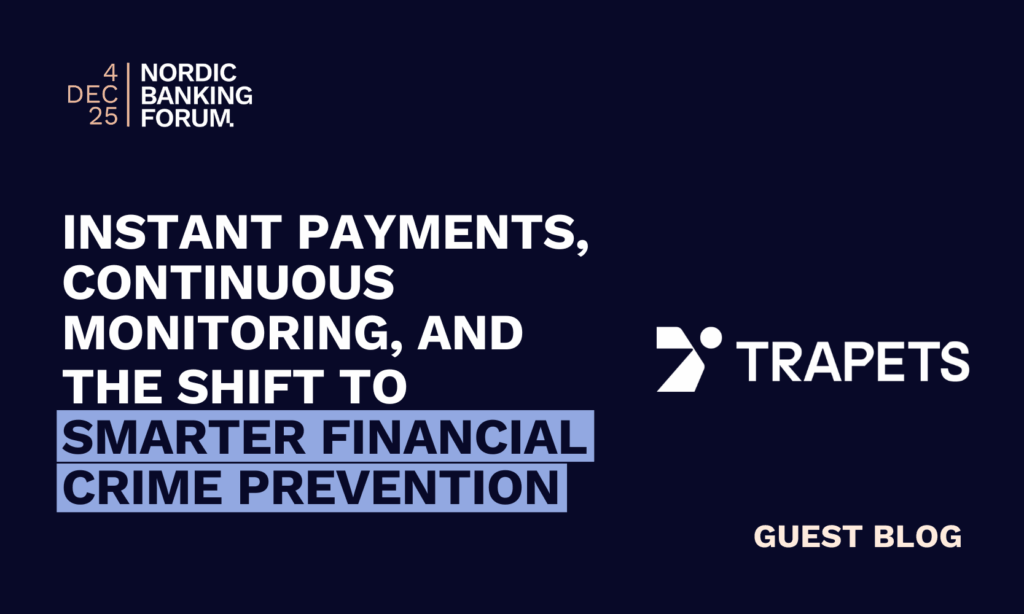
On Dec 4, 2025, Trapets will sponsor the Nordic Banking Forum in Helsinki.
For many years, AML compliance has been reactive. Firms gathered customer information at onboarding, reviewed accounts every few years, and investigated suspicious transactions after settlement.
That approach is no longer adequate. Payments now settle in seconds, cross borders, and operate 24/7. Once funds are moved, reversing or intervening becomes difficult. Regulators expect faster, more preventive action.
The EU is making this expectation explicit. Under the new Anti-Money Laundering Regulation (EU) 2024/1624, financial institutions must continuously apply a risk-based approach and ensure that controls remain effective over time.
The Instant Payments Regulation (EU) 2024/886 introduces rules tailored for real-time payments that further accelerate the shift from reactive to preventive approaches.
This direction shows that compliance cannot lag behind customers. It must act in parallel.
What proactive compliance means
To move from reactive compliance to proactive control is to change the posture: always watching, always updating, and always ready to act.
It means integrating customer due diligence, sanctions screening, transaction monitoring, and fraud prevention into a continuous, dynamic process rather than a set of periodic checks.
Below is how that looks across key AML workflows.
Customer due diligence: from onboarding to ongoing review
Traditional CDD (customer due diligence) has been onboarding-centric: verify identity, establish beneficial ownership, assess risk. Then revisit after fixed intervals.
Under the new regulatory regime, CDD must be continuous. The AML Regulation (EU 2024/1624) requires obliged entities to apply customer due diligence “during the business relationship,” adapting the measures as risk evolves.
To comply, firms should:
- Keep customer and ownership data up to date.
- Re-score risk profiles when new data emerges.
- Monitor triggers like changes in ownership, jurisdiction, or adverse media.
This approach is often called perpetual KYC. It ensures that when a transaction is initiated, the customer’s profile is already current and risk assessments reflect present reality.
Screening: from static checks to continuous watch
One of the most visible shifts is in sanctions screening. The Instant Payments Regulation (IPR) recognises that screening every instant transaction before execution is operationally infeasible.
Instead, it mandates that for certain intra-EU instant payments, payment service providers (PSPs) must maintain ongoing sanctions screening of their customer base and be able to interrupt payments when a customer becomes sanctioned.
Recital 25 to the IPR highlights the challenge of false positives under transaction-level screening and supports a model that reduces friction while preserving compliance.
Thus, screening shifts from:
- A daily batch or periodic check,
- To a live, event-driven regime where:
- Sanctions lists update immediately when published.
- Customer and counterparty databases are screened as new data arrives.
- Payment execution can be halted the moment a match is confirmed.
The European Banking Authority (EBA) has also updated its Guidelines on ML/TF Risk Factors (EBA/GL/2021/02, revised) to emphasise that screening (customer or transaction) should be “effective, up to date, and risk-based.”
For faster payment services, that implies controls must run as near to real time as possible.
In addition, the EBA guideline EBA/GL/2024/15 (applicable from 30 December 2025) formally requires PSPs and crypto-asset service providers (CASPs) to maintain adequate, reliable and calibrated screening systems and controls, which must update in response to newly adopted or amended restrictive measures.
This guideline reinforces the shift from periodic, batch-based screening toward an event-driven and real-time (or near-real-time) regime, encompassing screening of originator, payee, intermediaries and free-text fields, as well as the immediate freezing or interruption of transfers when a match or suspicion is confirmed.
Therefore, the IPR-driven transition to a live, event-driven screening model is strongly supported and complemented by the emerging EBA guideline framework.
Transaction monitoring: from detection to prevention
Traditionally, transaction monitoring has been reactive and payments have been analysed after processing, and alerts generated hours or days later. Today, the focus is shifting to preventive controls that identify and stop potentially illicit payments before execution, allowing institutions to act in real time rather than after the fact.
New rules (and supervisory expectations) demand that monitoring operate in parallel with payment execution:
- Payments are analysed in real time
- Anomalies and red flags are raised immediately.
- Escalation rules are triggered automatically, potentially halting flows or escalating to investigators before funds move beyond control.
This turns monitoring from a tool of detection into a mechanism of prevention.
Fraud prevention: from separate function to unified strategy
Fraud and AML have often been handled in separate silos, compliance for regulatory risk, and fraud for operational or customer risk. Yet increasingly, fraud signals can be proxies or early indicators of financial crime.
A proactive compliance model blends AML and fraud controls:
- Shared data (transaction history, behavioural patterns, device data).
- Risk rules or triggers that span both domains.
- Joint case handling when anomalies surface.
This integration strengthens each domain: fraud prevention helps AML, and AML context sharpens fraud detection.
The technical foundation for continuous monitoring
Proactive compliance rests on reliable systems and data flows. The infrastructure must support:
- Streaming analytics that score transactions as they occur.
- Graph and network analysis to connect accounts, devices, counterparties.
- Cloud-first platforms able to scale with instant payment volume.
- Automated data feeds (sanctions updates, adverse media, KYC changes) that flow seamlessly into risk engines.
These components make it possible to operate continuously rather than periodically.
Governance and practical challenges
Real-time controls bring new demands. Firms must ensure:
- Data inputs and models are high quality.
- Privacy and data protection (e.g. GDPR) are respected at every step.
- Automated decisions can be explained, audited, and overridden.
- Controls are tested and validated, not just implemented.
Supervisory authorities (including national regulators and the future AMLA, per the new EU AML framework) will expect evidence not only of automation, but of effectiveness, accountability, and resilience.
Europe’s strategic direction
The EU is building a harmonised, high-speed AML framework. Key pillars include:
- Regulation (EU) 2024/1624 – the new AML Regulation with direct effect across Member States
- Regulation (EU) 2024/886 – the Instant Payments Regulation, tailoring obligations for instant euro payments
- EBA Guidelines on ML/TF Risk Factors (EBA/GL/2021/02, revised) – setting standards for risk-based customer and transaction screening
- EBA/GL/2024/14 – strengthening ML/TF risk management systems, governance and group-wide coordination
- EBA/GL/2024/15 – setting expectations for effective, calibrated sanctions-screening systems that update immediately when restrictive measures change
- Regulation (EU) 2023/1113 – the Travel Rule for crypto-assets, ensuring originator and beneficiary data accompany transfers
- Regulation (EU) 2024/1620 – establishing the AMLA to centrally supervise high-risk institutions and enforce the single rulebook
Together, these reforms push institutions toward a continuous, real-time compliance posture rather than fragmented, delayed controls.
Trapets: how we enable proactive compliance
At Trapets, we support financial institutions in making this shift.
We deliver near-real-time EU sanctions data and automated customer screening, enabling perpetual KYC so customer risk profiles remain up to date.
We also provide real-time transaction monitoring, evaluating every payment’s parties, countries, message text, and context in one unified process.
Our solution helps institutions meet and exceed EU regulatory expectations, enabling not just compliance, but proactive prevention of financial crime.
Conclusion: staying ahead of risk
The AML landscape in Europe is shifting.
Proactive compliance means maintaining up-to-date customer profiles, continuously screening, monitoring transactions as they occur, and bridging fraud with AML.
It’s not about speed for its own sake; it’s about catching risk before it disrupts the system.
AUTHOR

Marina Sundin, Product marketing Manager, Trapets
A curious language nerd with a background spanning B2C and B2B marketing and product, Marina Sundin loves exploring how different perspectives fit together to form the bigger picture.
TRAPETS
Want to hear more? Access tons of free and paid courses exploring the next chapter in banking, insurance and finance at the Digital Banking Academy!